Buy-to-Let Refurbishment Case Study, London: A £115k Uplift in Oval (SE5)
A £170k ex-council flat in Oval, a £40k refurb, and a £325k valuation. Here's exactly what we did to this Kirwyn Way flat, and the numbers behind the uplift.

Quick answer: We bought a dated one-bedroom ex-council flat in Oval (SE5) for £170,000, spent £40,000 on a full refurbishment, and had it valued at £325,000 once the work was done — a £115,000 uplift over total invested. The two things that actually drove that number: reclaiming usable space the original layout wasted, and specifying a kitchen and bathroom that let and value well. The two things that took the most management time had nothing to do with the refurbishment itself: the block's communal heating system and Southwark's freeholder consent process.
Every deal we take on has to prove our process, not just our budget. This Kirwyn Way flat is a good example: a tired one-bedroom ex-council flat in Oval (Camberwell, SE5) that we bought for £170,000, refurbished for £40,000, and had valued at £325,000 once the work was done. Here is exactly what we did, the challenges specific to a London ex-council block, and the numbers behind the uplift. See the finished flat's stats and photo gallery on its project page.
Why we bought a one-bedroom ex-council flat in Oval
The buying case was simple. Oval and Camberwell sit in Zone 2 with strong transport links and consistent tenant demand, but the ground-floor flat we found was dated, its space was poorly used, and it had an inefficient gas-fed hot water setup that put off most buyers. That combination — a good location and a property the market had discounted for cosmetic and services reasons — is exactly the kind of buy-to-let refurbishment we look for. The gap between the discounted purchase price and what a well-specified flat would be worth was the whole opportunity.
The starting point: what we were working with
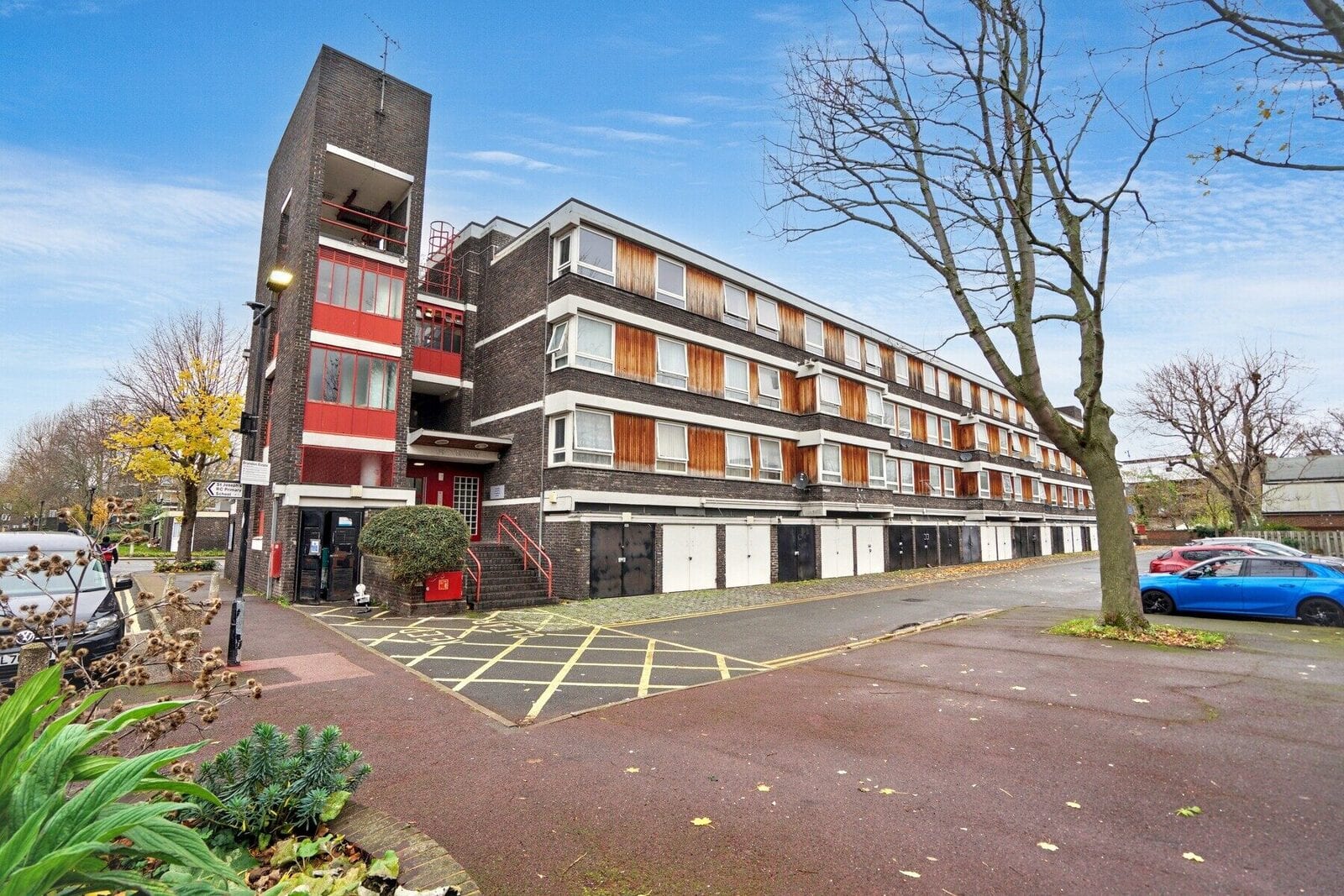
The flat is on the ground floor of a 1960s reinforced-concrete framed block, roughly 52 sqm, with its own rear patio. Inside it was structurally sound but tired: original finishes throughout, boxed-in service enclosures eating into the kitchen, a bulky cupboard housing a gravity-fed hot water cylinder in the bathroom, and a built-in wardrobe partition closing down the bedroom. Nothing we wanted to remove was load-bearing — a structural engineer's report confirmed the internal partitions and cupboards were lightweight, non-structural elements typical of the period — so we could reclaim the usable space without touching the concrete frame.
What we did: the refurbishment scope
We stripped the flat back and rebuilt it to a durable, lettable spec. The headline works were:
- Reclaimed space: removed the redundant service enclosures in the kitchen, the old cylinder cupboard in the bathroom, and the bedroom wardrobe partition, then made good throughout.
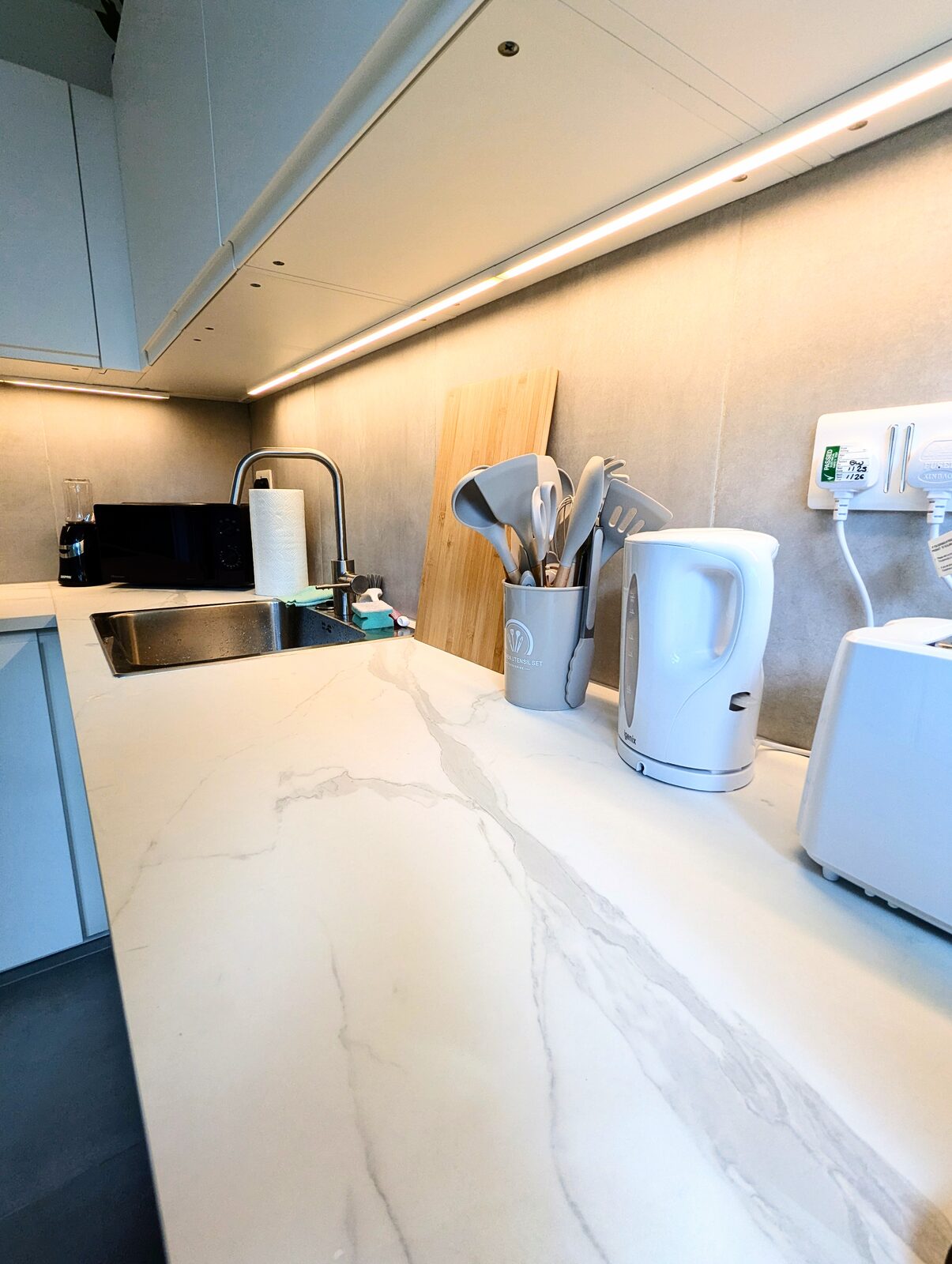
- New kitchen: an IKEA METOD kitchen with matt-white VOXTORP fronts and a marble-effect EKBACKEN worktop, an induction hob with cooker hood in place of the old gas supply, integrated fridge-freezer, slimline dishwasher and washer-dryer, slip-resistant porcelain flooring and a tiled splashback.
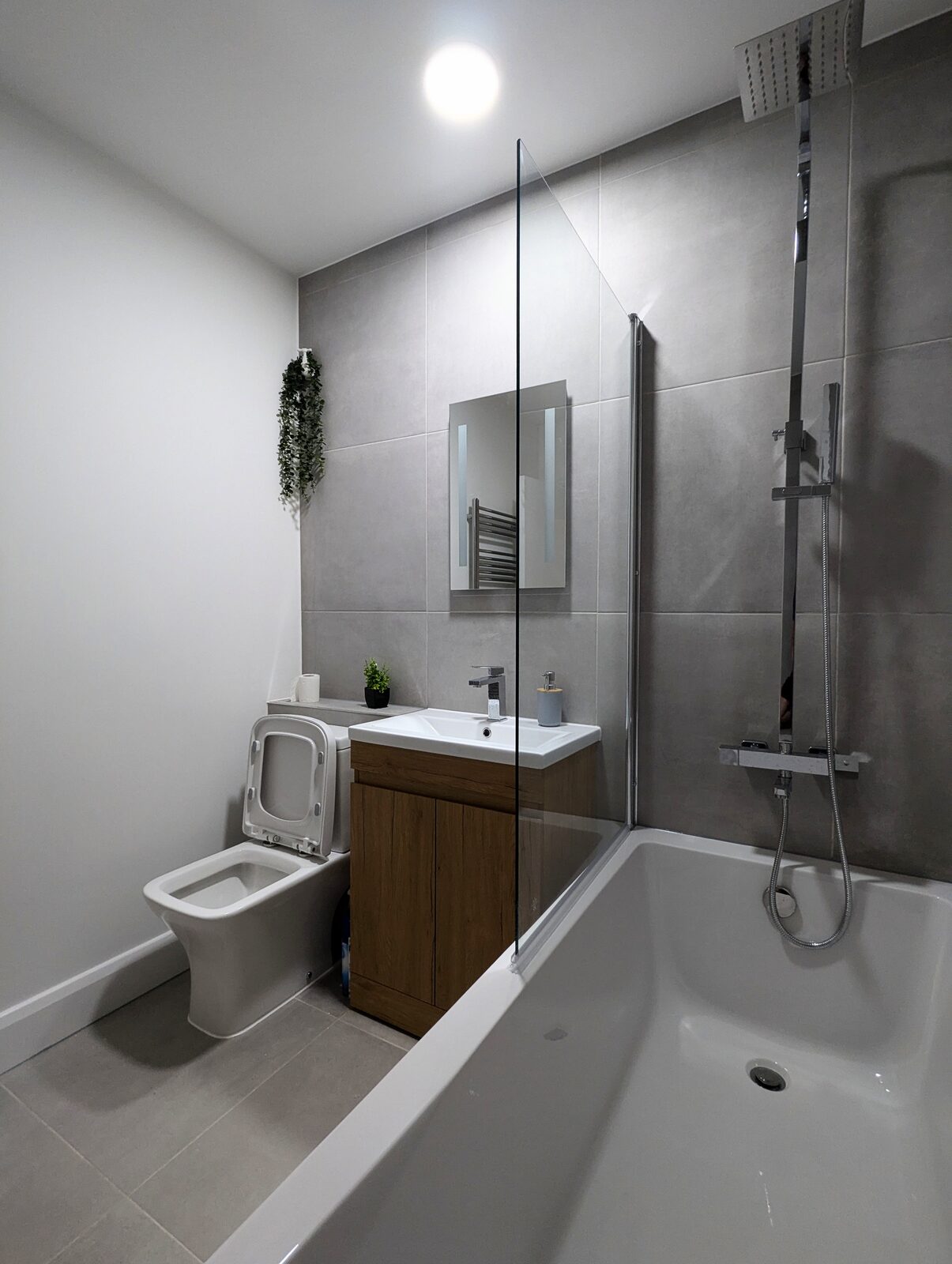
- New bathroom: a new 1800mm bath, basin and WC, thermostatic shower and toughened glass screen, an oak-effect vanity and illuminated mirror, with full Schlüter waterproofing (KERDI to the walls, DITRA to the floor) behind large-format grey porcelain tiling.
- Hot water and heating: the old gas supply was permanently decommissioned and capped by a Gas Safe engineer, replaced with a new 150-litre OSO slimline unvented cylinder commissioned under G3 — a real quality-of-life upgrade for a tenant.
- Electrics and fire safety: inspection and rewiring where needed, a new consumer unit, dedicated circuits for the kitchen and cylinder, and mains-wired LD2 smoke and heat detection, all certified to Part P and BS 7671.
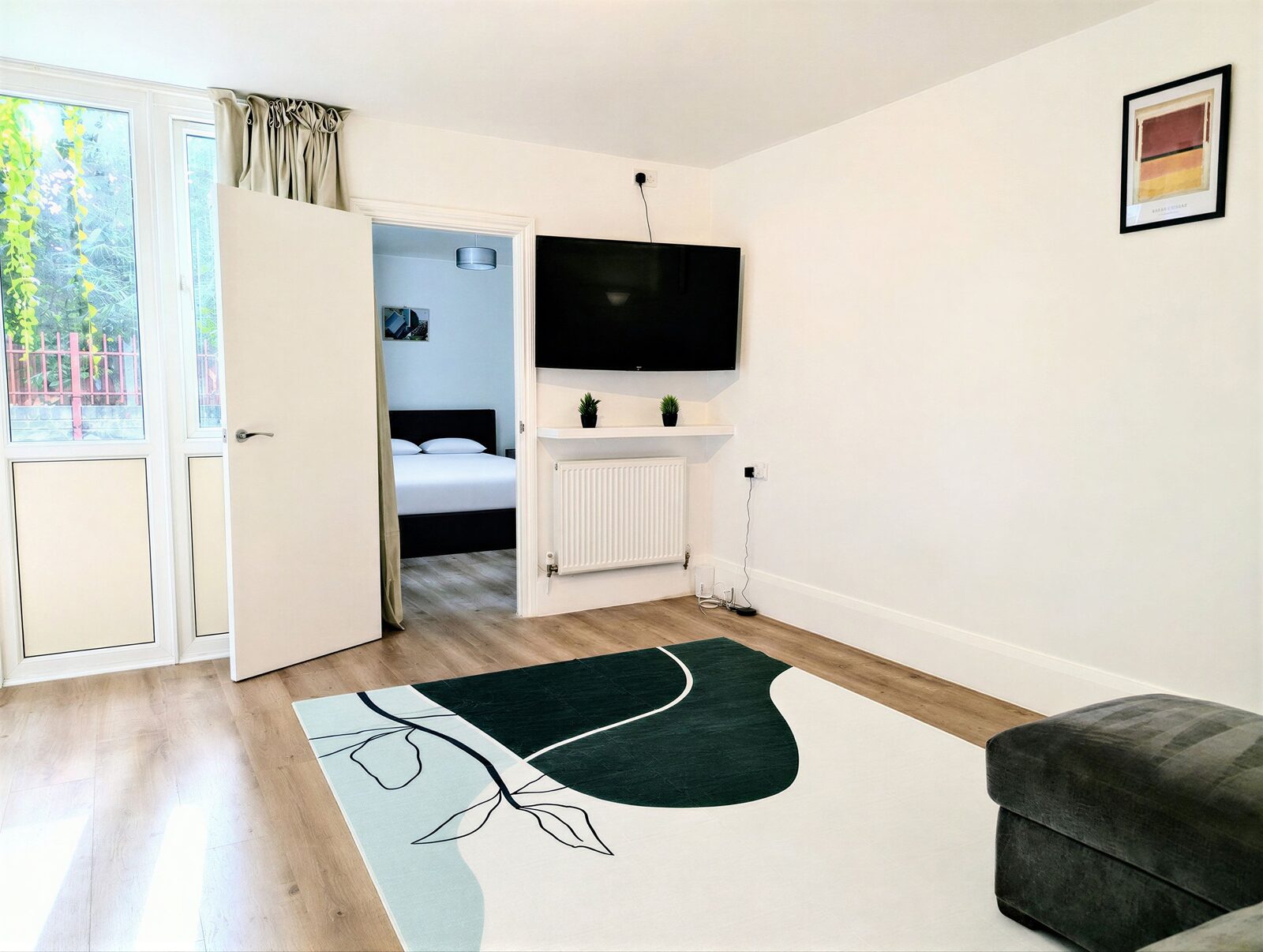
- Finishes: re-skimmed and repainted walls and ceilings throughout, oak-toned laminate flooring with acoustic underlay and new skirting to the living areas, hall and bedroom, and new internal doors including an FD30S fire door to the kitchen.
- Outdoor space: the rear patio was relaid with outdoor porcelain paving and the railings and brickwork treated and repainted — a private outdoor area is a genuine differentiator for a ground-floor London let.
The real challenges: communal heating and freeholder consent
This is where an ex-council block differs from a standard flat refurbishment, and where most of our project management time went.
Communal district heating. The block runs on a communal district heating system, so the radiators aren't fed by anything inside the flat — they connect to shared risers. We kept the flat on the communal system and reconnected new radiators and controls on a like-for-like basis, with no alteration to the communal risers. Any work that touches that system has to be coordinated with the freeholder's engineering team, including a block shutdown booked with at least 14 days' notice. That has to be sequenced into the programme early; you cannot treat it as a normal plumbing job.
Southwark leasehold consent. The flat is leasehold with the London Borough of Southwark as freeholder, so we needed formal Permission to Alter before starting. We submitted the application in February 2026 with the architect's drawings and scope. Southwark reclassified the job as a major alteration because removing the cupboards changed the layout, which meant a higher fee, and the application then had to clear a fire-safety surveyor's review before Consent in Principle was issued on 16 April 2026. The lesson we'd pass on: budget realistically for freeholder consent on any ex-council leasehold — it sits on the critical path, and works cannot legitimately start without it.
The numbers: what a £40k refurb returned
Here is the deal end to end:
- Purchase price: £170,000
- Refurbishment cost: £40,000
- Total invested: £210,000
- Post-refurbishment bank valuation: £325,000
- Value uplift above purchase price: £155,000
- Value uplift above total invested: £115,000 (around 55% over total cost)
- Monthly rent achieved: £2,000 (assured shorthold tenancy)
- Annual rent: £24,000
- Gross yield on total invested: ~11.4%
- Gross yield on end valuation: ~7.4%
These are gross project figures before finance, tax, utilities, service charge and other operating costs. The uplift is what makes this a BRRR deal rather than a simple flip. At a typical 75% loan-to-value refinance against the £325,000 valuation, the new mortgage would be around £243,750 — more than the £210,000 we put in — which means the full deposit and refurb budget can be recycled into the next project while we keep the flat and the income. That is the whole point of the model: force the value up through the works, then pull the capital back out.
The outcome
The flat is now complete and let on an assured shorthold tenancy at £2,000 a month. The on-site works ran to an eight-to-ten-week programme through spring and summer 2026, on top of the consent period that preceded it. What turned a discounted, dated flat into a £325,000 asset wasn't anything exotic — it was buying the right stock at the right price, specifying finishes that let and value well, and managing the parts most investors underestimate: communal services and freeholder consent. That is the process we repeat on every project.
Frequently Asked Questions
Why does an ex-council flat need freeholder consent to refurbish?
Because it's leasehold, not because it's ex-council specifically — any leasehold flat needing structural or layout changes typically needs the freeholder's Permission to Alter before work starts. What made this one slower was Southwark reclassifying the job as a major alteration once the cupboard removals were shown to change the layout, which added a fire-safety surveyor's review to the timeline.
Why keep the flat on communal district heating instead of installing independent heating?
The radiators connect to shared risers serving the whole block, not a supply inside the flat itself, so replacing the system entirely would mean altering communal infrastructure — a far larger, more disruptive undertaking than the flat itself justified. Reconnecting new radiators and controls like-for-like on the existing communal system delivered the upgrade tenants actually notice without that scope.
Is a £115,000 uplift on a £40,000 refurb typical?
No — treat this as an illustrative example of what's achievable on the right property in the right location, not a typical or guaranteed outcome. The uplift here reflects a specific combination: a genuine discount at purchase for cosmetic and services reasons, a strong Zone 2 location, and a refurbishment scope that happened to unlock real usable space. Every project's numbers depend on its own purchase price, comparable valuations, and refurbishment scope.
Why was this a BRRR deal rather than a flip?
Because the post-refurbishment valuation supports a refinance that returns more than the total invested, letting us keep the flat and its rental income rather than needing to sell to recover capital. At a typical 75% LTV refinance against the £325,000 valuation, the new mortgage would be around £243,750 — more than the £210,000 put in.
Key Takeaways
- The value uplift came from two decisions: reclaiming wasted space and specifying a kitchen and bathroom that let and value well — not from anything unusual or exotic.
- Ex-council leasehold flats carry real project-management overhead beyond the refurbishment itself: communal heating systems and freeholder consent both sit on the critical path.
- Freeholder consent for an ex-council leasehold should be budgeted with real time and cost contingency — work cannot legitimately start without it.
- A structural engineer's report confirming non-load-bearing elements is what let us reclaim space without touching the concrete frame — get that confirmation before scoping demolition, not after.
- The refinance economics, not the sale price, are what make a project like this a BRRR deal rather than a simple flip.